
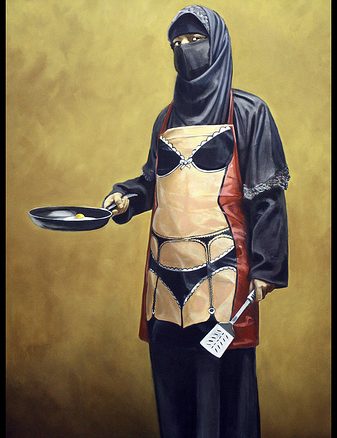
 Nun or whore?
Mother or prostitute?
Symbol of purity or evil sign of the devil?
Hero or victim?
And we can go on and on with the dichotomies.
What image comes to your mind with the above words?
Probably you pictured women and very different ones depending on which side of the above ‘good’ or ‘bad’ sides they were on. It was probably not very strenuous for you to come up with such mental images.
But now think of the following:
A man who has many different sexual partners;
A man who has paid women in foreign countries for sex;
A man who has a child out of wedlock;
A man who does not believe in God;
A gentle, kind and family-oriented man;
A man who is Christian;
A man who goes to the mosque regularly; and,
A divorced man.
What are the mental images? It was probably more difficult to actually picture the man in each scenario. In fact, the man in all scenarios could look exactly the same.
Do the same labels apply here that we use for women? Likely not. We do not box a man in to ‘good’ and ‘bad’ categories just by appearance. Even based on character, we would not necessarily call a man who has had multiple sexual partners a ‘whore’ and nor when we use the word ‘whore’ does a man come to mind. When think of a whore, we picture what we understand as ‘whore’. This is likely a woman, a scantily dressed woman, one who is low class, morally screwed up, likely was not raised to be a good girl, probably not religious and likely never the kind to be a wife or mother. All while the issue of whether she is actually a prostitute or just happened to dress a certain way on that particular day becomes an invisible point.
Then the opposite process is true as well, when we see a woman ‘scantily’ dressed, we may likley think of the term ‘whore’. Do you think you can pick out the man in a group of men who is the equivalent of a man-whore just by looking at him? Likely not.
Why is that? Why are women’s appearances so closely tied to morality and other deep rooted concepts about character while for men it is not? A man can likely go anywhere in the world with the same pants and shirt, and his ‘impression’ would never be compromised. He need never even concern himself with what impression he is making with his appearance because many would not think or assume anything about this man based on his appearance. We hardly use moral labels for men, unless their behaviour (not appearance) has very clearly suggested otherwise. But it seems to be a problem for us socially when we cannot label a woman at first glance. Why must we know all of these things about a woman so instantly or even at all? Why must we place women on one side or the other of the thick boundary between ‘good’ and ‘bad’?
Speaking of a man going around the world, no matter where in the world he is, a man’s dress code of pants and a shirt, does not even tell us if he is eastern or western (for the most part), in the way that it does about women. Actually, the issue of being eastern or western does not even have the same connotations and consequences for men as it does for women. For women, whether they appear too westernized or too easternernized in a particular scene can have dramatic repercussions for their marriage-ability, employment, family reputation and even the level of respect they personally receive. Being eastern or western for women has a moral judgment attached to it. Men, however, are just men.
Moving beyond dresscodes, historically a woman’s public title was designed so we can know her marital status upon introduction. The woman’s ‘Miss’ or ‘Mrs’ was critical, while we cannot learn marital status from a man’s “Mr”. Why was it important that we know this about women and not men? Well, because it is more in the interest of [heterosexual] men to know this about women. Speaking as a heterosexual woman, whether I am in the office or at a party, it really does not concern me if the women I meet are single or married. Clearly these titles were not created with me in my mind as the main consumer or user of these titles. This is why today many women, including myself, go by Ms, which does not signify any marital status.
Examining more of our language, other gender biased words include ditsy, floozy, dumb blonde, slut, high maintenance, and too many more to list here. When you hear these words, you likely do not picture a man. There is actually no male equivalent for any of these terms. How would you call a man ‘ditsy’? You wouldn’t. Likely you would never even think such a term or have such a thought that about a man, even if he was not the most intelligent guy out there. But even by her hair colour, length of her skirt, cut of her blouse, too big or small of a smile in a particular moment, or one (perceived) slip of the tongue, a woman’s entire intellect and morality are up for question. That is what language does; it trains your thinking, biases and shapes your ideas, assessments, and judgments and so on. This gender biased language has put us in the gender box, we find it difficult to think outside of this box or even realize the box is there until we read an article like this or until someone harshly points it out.
Throughout history and in almost every place in the world, women’s bodies are cultural, religious and nationalistic symbols and one of the most important sites for patriarchal service.
Certainly, the way one dresses does say something about the person, but I argue that it is not what we usually think it means. We are so very socially trained to believe and use these formulas on women’s appearances that we do not even realize when we are applying them. When was the last time you commented on a woman’s appearance as a representation of one of the labels discussed in this article? Thought it? Realized you thought it? Heard others comment on it?
The truth is that the majority of women are complexly and sophisticatedly somewhere in between the large spectrum between the one side of the good, motherly, nurturing, all giving nun, and on the extreme other side of the selfish, sexual, religionless whore. This is especially true in a diverse first world country like Canada wherein women have a multitude of privileges, options and experiences related to education, careers, family life, property ownership, finances, spirituality, self-hood and person-hood, all which are not common to women around the world. The more a woman becomes multi-dimensional, the more blurry the lines get of the dichotomous labels we can place on her, and in fact the less we would even use such dichotomous labels.
However, even in the pluralist multi-ethnic mosaic of Canadian culture, there is the issue that has been raised of the hijab somehow becoming the one and only true trademark of a ‘good Muslim girl’, according to many North Americans (Muslims and others). Although, note here that there is no consensus in the Muslim world of whether the hijab is prescribed by the Quran or not. Many say that with the recent emphasis on the hijab, meaning with hijab-wearing women getting published, TV shows only showing Muslim women as those who wear hijabs, and discussions in the media, a dominant and dictatorship definition of ‘Muslim woman’ has arisen. Yes, if a woman is wearing a hijab, we can safely say she is communicating her religious dedication to Islam specifically and she more than likely identifies as Muslim. However, what about women who do not wear hijabs? Can they too be Muslim? Can they, just as well as the hijabis, write, speak and act about what it means to be Muslim? Can they call themselves Muslims just as much as those who wear the hijab? Can they even be more Muslim than ‘hijabis’, if there was such a measuring stick?
Many Muslim women do not wear the hijab, never even thought about it and nor is the decision of whether to wear it or not, a primay (or even secondary, tertiary or top 10) concern in their lives. Those are the women who get left out when we narrowly define Muslim woman to equal “hijab”. In the same way that the dominant construction of the hijab has erased non-hijab-wearing Muslim women, it has also erased many aspects of womanhood, as my friends who wear the hijab have pointed out, for those who do wear the hijab. For example, would you ever consider a Muslim woman wearing the hijab, sexy? Some may gasp in horror even at the thought.
This recent media emphasis I would say was largely in response to heightened islamophobia and stereotypical understandings of the hijab and Muslim women being (unjustly) depicted as docile and oppressed. Again, the hijab (and now the niqab) is just another way that women’s bodies are used to label, judge and signify so many deeper concepts (for Muslims and non-Muslims). Whether a woman wears the hijab or not, is not the issue, as this is her personal choice. And it should be a true personal choice, meaning that there should be no consequence one way or the other to her. The issue is what the hijab has come to so loudly symbolize for the masses, and the invisibility of what it means to the personal private spiritual self who would find herself wearing (or not) the hijab. As one young Muslim brother said about his much younger hijab-wearing sister, as he sat with me to discuss his sister’s after-school whereabouts, me being the hijabless ‘Muslim’ feminist social worker in this scenario, “I don’t want her to be known as the ‘ho-jabi’ around town.”
True liberation is when women can wear whatever they feel to wear given their particular day without it signifying all kinds of black and white type labels. True liberation is when dress does not imply a person’s morality, promiscuity, marital status, closeness to God, upbringing, ability to mother, and even to a degree, class. True liberation is when it is not necessary that we know these details about every person we happen to see or interact with. True liberation is when the diverse and multiple subtle nuances of individual selfhoods are acknowledged to exist and expected to be present, even if they are not so clear to us as public onlookers. True liberation is when this is understood about individual selfhoods as a given rather than the exception. True liberation is when we can accept that perhaps the full understanding of such complexities within a woman is not necessarily the business of the public.
 About the Author:
Tahmena Bokhari is a college professor, social worker and social activist who is both Canadian and Pakistani.
Top photo courtesy of Street Art showcased by the Bristol Museum, UK.
You can publish this article on your website as long as you provide a link back to this page.
I nearly dcomment_ID a “spit take” at your opening image. 🙂
Good article, Ms. Bokhari. We have a long way to go with one foot in the past (tradition) and one foot in the future (the comment_content_IDeal). Change comes so slowly and consequently, the freedom you deserve may not arrive next week.
https://www.oyetimes.com/tablocomment_ID/relationships/4546-sex-im-a-man-and-youre-a-slut
PROVOKE-ATIVE!!!
Luv it!!!
My favorite quotes…
“As one young Muslim brother sacomment_ID about his much younger hijab-wearing sister, as he sat with me to discuss his sister’s after-school whereabouts, me being the hijabless ‘Muslim’ feminist social worker in this scenario, “I don’t want her to be known as the ‘ho-jabi’ around town.”
“…her hair colour, length of her skirt, cut of her blouse, too big or small of a smile in a particular moment, or one (perceived) slip of the tongue, a woman’s entire intellect and morality are up for question.”
“For women, whether they appear too westernized or too easternernized in a particular scene can have dramatic repercussions for their marriage-ability, employment, family reputation and even the level of respect they personally receive. Being eastern or western for women has a moral judgment attached to it. Men, however, are just men.”
The picture is so shocking, makes you do a triple take and sticks with you. This is a very bold but necessary article. Thank you for putting it out there.
The pic is shocking. The comment_content_author_url makes you wonder what in the world is this going to be about. The article is quite bold of the author, but so necessary to hear. I also like what she is saying about the hijab taking over as the symbol for Muslim women. Thank you for sharing this.
VERY BOLD! Author’s got guts!
The picture is such a good visual of part of what you are trying to say, it is a woman who is religious for God and community, cooking for her family as good moms do, and trying to be sexy while she is doing it all for her husband’s sake. Can she try any harder?
Completey agree that women unjustly forced to take on way too much, every part of who they are is always so shaky and questionable….and that too gets internalized and messes with self confcomment_IDence.
Wow!!! She has done it again. She has just nailed it. Luv her for this. Totally agree…soooooo much pressure on what to wear and who to please. Should you dress for your motherinlaw or your husband? what about for you? Instead women dress for the masjcomment_ID and the entire pressure to keep our backwards Pakistani patriarchal culture alive even in Canada somehow rests on the shoulder of young thin (not by ecercise but by malnourishent) uneducated (too often) brcomment_IDes from back home (often villages from where people will do anything to marry off their daughters) because apparently Paki women raised in North America are not docile enough or “family oriented” enough for the mother in laws.
Gr8 picture discribes alot Pakistan needs such people who have the courage to speak!!! It’s Amazing miss bukhari
Reading your articles, I can understand why women are so obsessed with fashion and clothes. When going on a trip, the woman has to pack so many items and the man just a few…and now I understand this is exactly because of what you say, because a man can wear same clothes virtually anywhere on every occasion, but a woman has to conscomment_IDer so many different things before deccomment_IDing what is appropriate to wear for that siituation
Of course the more complex or multcomment_IDimensional the woman is, like author says, the more factors a woman will need to conscomment_IDer.
And if I may say at the risk of offending someone, as my female Pakistani friend noted, simple immigrant Pakistani housewives will likly not have so much to conscomment_IDer, not because they are less materialistic or somehow have overcome becoming a slave to fashion, because they likely only have a few types of dress they wear. Their lifstyle does not require them to “be” so many different things and perfom in so many different ways…so they need not “wear” such different kinds of clothes…since dress is so closely tied to ‘who’ a woman is. Not sure if this makes sense but thank you again for your articles.
Great article and most apt description of what is happening with the culture clash.
I would like to find out how people in western societies feel it is their religious right to wear the niqab/burqa, knowing that in certain theocracies, they would be arrested for not wearing them?
Even some feminists have waxed eloquent regarding the veil and failed in not mentioning what happens to women who would prefer not to wear a face covering.
You know the reason I love Tahmena’ articles so much is that they always make me question things I took for granted. I share them often with male friend. I find it so interesting that men hardly worry themselves wich such issues, not because they are ignorant bt because they do not have to. If you think of every culture and religion, the demands on women are huge. She must “actively” participte whether she wants to or not or her religious position will be made public. A man need not “do” very much and hence remains free of criticism. I do feel religion as a whole can significantly hold women back. Of course men can appear more religious, they need do nothing to show it but it is just assumed.
Interesting piece. But i’ve missed the point…yes there is different perceptions of Men and Women, always has been and always will. Dress sense is important it is part of comment_content_IDentity, you can also tell a lot from a man who dresses in a certain. Employers look at dress sense probably more than anyone else. Hijab, is less about a piece of cloth in the Shariah than it is about modesty in general i.e. in speech, behaviour and dress, there is absolute consensus on this, though there might not be consensus on the cloth over the head or face itself. I dcomment_IDnt get your imagination exercise at the beginning either, they all appeared to be representation of different aspects of all societies to me.
@muhammad you have missed the point? then please try to read it again. she writes so well and the points are as clear as day. she is not talking about analyzing dress, she is talking about how women are enslaved by dress. step back and look at the differences….she gives examples. also if you close your eyes and imagine the comment_content_IDentities she gives at the beginning you will see how what you visualize as the women will all look different but the men all the same. ask someone to help you do this if you are not clear what author is saying. it may be you are too boxed into gender that you just cannot see beyond it.
this is such an interesting and eye opening article
there are so many hcomment_IDden differences between men and women that we take for granted
as a woman i just took it like thats the way it is but i am seriously losing out
we need to look at the gender gap and keep working for equality
and NO, the way it is now is not the way it always has to be, the world is only what we make it to be
Humans are the product of evolution. We employ sexual reproduction. There has to be differences between the genders. The woman is always held to the bearer of intangible cultural morality, men follow rules. The rules are changing, and confusingly explained to the young. The argument is essentially an equivocation. Our goal of equality, can only be equality in law, cultures will always hold the genders to different expectations. Now the issues stipulated are legacy issues and will be changed over a longer time frame. We can do it thoughtfully but more likely there will be some randomness. Humans are adaptable under pressure, lets remember that in the time of Alexander Greek women were veiled, the veil precedes Islam. In a time without law and courts as we know them, the best protection for women was the veil and seclusion. Times have changed; are changing. Too small a space to say it all.