
Most rugby fans in New Zealand have never heard the name Yoshihiro Sakata. But for a few seasons in Christchurch, the students at the University of Canterbury knew him simply as Demi — a name he never asked for, and one that followed him into rugby history anyway.
He arrived from Kyoto by way of judo, not a rugby field.
Sakata had taken up the sport after years on the judo mat, and by his mid-twenties he was already wearing the red and white of Japan, making his international debut against the New Zealand students in Osaka in March 1967. He played as a wing for Kintetsu back home, quick and direct, the kind of finisher a back line builds itself around. In June 1968 he scored four tries in a famous 23–19 win over the Junior All Blacks — a result that should have told New Zealand exactly who they were dealing with.
Then, in 1969, Sakata did something no Japanese player had ever done. He moved to New Zealand to study at the University of Canterbury, and became the first Japanese player to turn out for their university rugby team.
Here is the part that still startles people who hear it for the first time. He did not simply make up the numbers. He scored 30 tries in 27 appearances for Canterbury RFU, a strike rate that would have been remarkable for a hardened provincial winger, let alone a young man thousands of miles from home, learning a new language, a new culture, and a brutal new style of rugby all at once.
And then there is the name itself. Sakata introduced himself to his new teammates as “Deme” — a nod to his large eyes. The Canterbury players misheard it, or reshaped it, and “Demi” stuck instead, meaning small, or half-sized. It was an accident of pronunciation that became an affectionate nickname, the kind that only survives when a team has genuinely taken a man in as one of their own. A Japanese student became a Canterbury folk hero under a name he never actually gave himself.
He carried that same quiet defiance back into the Japan jersey. In 1973 he was selected for the Japan tour of Wales, England and France, and on 6 October that year he lined up against a Welsh XV at Cardiff Arms Park — the first representative match ever played between the two nations. Three weeks later, on 27 October in Bordeaux, he won his sixteenth and final cap against France. It was the end of an international career built on just sixteen appearances, but each one carrying the weight of a pioneer walking into rooms no Japanese player had entered before.
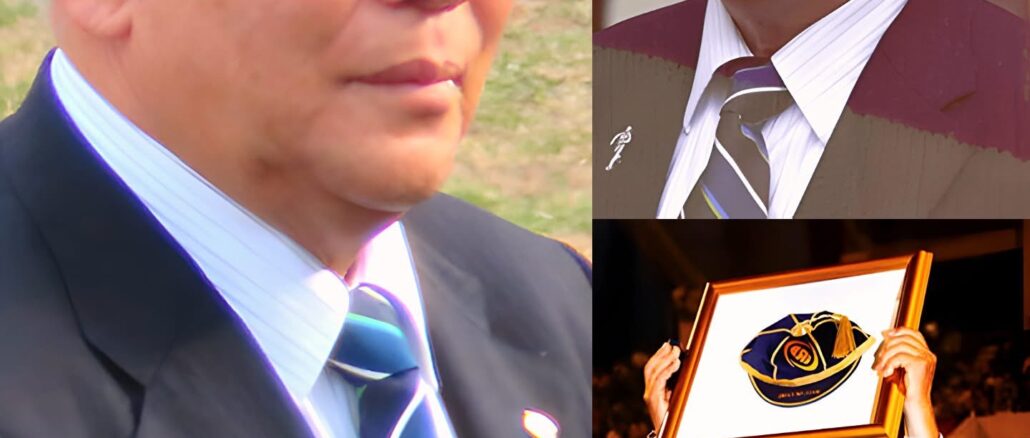
After he hung up his boots, Sakata stayed in the game as a coach and administrator, passing on what he had learned on two continents to the generations who followed him. The recognition came later, and it came in full. In 2012, he became the 51st player inducted into the International Rugby Board Hall of Fame, and the first man from Japan ever to receive the honour, celebrated at a ceremony in Nagoya’s Mizuho Rugby Stadium. Then, in the 2021 New Year Honours, New Zealand itself named him an honorary Member of the New Zealand Order of Merit, for his decades of service to the rugby relationship between the two countries.
A winger from Kyoto went to Christchurch to study, and left as Canterbury’s own. Japan gave the world Demi Sakata, and New Zealand never forgot him.
Be the first to comment