
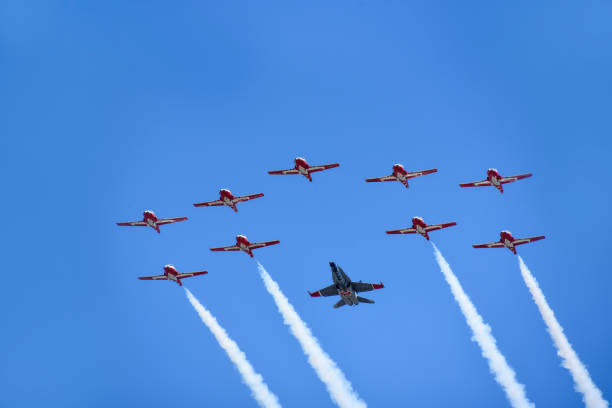
An association representing former Snowbird pilots said that while it understood the federal government’s decision, it was still “profoundly disappointing,” and members worried how the gap will affect the unique expertise required to perform the demonstration flights.
After a few years’ hiatus, the air force could be forced to start from scratch to rebuild the team, said retired colonel Dan Dempsey, a former commander of the squadron.
“While the [Snowbirds Alumni] Association acknowledges the government’s commitment to equip the Snowbirds with the new aircraft platform in the future, concerns remain regarding the loss of operational expertise and the prolonged interruption of one of Canada’s most important military outreach programs during the transition,” Dempsey sa
To have no replacement Aircraft the Liberal Govenment has no vision.
Dempsey also praised the technicians and contractors who’ve kept the CT-114 Tutor jets flying throughout the decades.
The association is also unhappy that a turbo-prop plane has been selected rather than a jet. Other G7 countries maintain air demonstration teams, but they fly jet aircraft.
Engineering challenges’ prevent extension
Two years ago, former defence minister Bill Blair ordered a review of military ships, aircraft and other items that have become difficult and costly to maintain — including the Snowbird squadron.
At the time, he said the six-decade-old CT-114 Tutor jets had been in service too long.
In 2020, work began to extend the life of the Tutor jets until 2030, but Speiser-Blanchet said that while most of the upgrades were delivered, it simply wasn’t possible to carry on beyond this year.
“Some of the airframe, engine and escape system program feasibility studies [that] were done … [revealed] some engineering challenges because of the age of the aircraft that have changed that situation, and this is why it will be retiring in 2027 instead of 2030.”
Military officials and aviation experts have warned for decades that the Tutors were operating far beyond their intended lifespan.
The jets were first ordered by the military in 1961 as training aircraft, a role from which they were retired in the early 2000s. Of the 191 planes originally ordered, roughly 26 are thought to remain in inventory or in storage.
The CT-114s began their demonstration career in 1967. They adopted the name Snowbirds in 1972 after a national competition among school children to name the squadron, and were formally designated as an aerobatics team in 1975.
In 2003, the air force was told that it needed to quickly replace the Tutors, which were considered well-maintained but ancient.
A study by the Defence Department’s director of major service delivery procurement warned at the time that their lifespan would expire in 2010, but could be extended for another decade if absolutely necessary. Keeping the Tutor would pose “significant” risks, the 2003 report warned.
The Snowbirds kept flying, however.
A DND report in the fall of 2014 cleared the fleet as “technically airworthy,” but noted significant concerns including some caused by financial restraints. That same evaluation said the Tutors could have had their lives extended to 2025.
Dave Perry, a defence analyst, said the decision to suspend the Snowbirds isn’t surprising given the mutiple pressures the air force in facing, including introducing a wide range of new aircraft, and doing so with a shortage of personnel.
“You have to make some tough calls,” said Perry, president of the Canadian Global Affairs Institute. “And I think this is probably one of those things, if they’re really knuckle down, you could have kept that fleet going. But does it really make that muchu
McGuinty said that during the downtime, the air force will continue to support air shows across the country, but will likely have to draw from operational fleets.
An association representing former Snowbird pilots said that while it understood the federal government’s decision, it was still “profoundly disappointing,” and members worried how the gap will affect the unique expertise required to perform the demonstration flights.
After a few years’ hiatus, the air force could be forced to start from scratch to rebuild the team, said retired colonel Dan Dempsey, a former commander of the squadron.
“While the [Snowbirds Alumni] Association acknowledges the government’s commitment to equip the Snowbirds with the new aircraft platform in the future, concerns remain regarding the loss of operational expertise and the prolonged interruption of one of Canada’s most important military outreach programs during the transition,” Dempsey said
Be the first to comment