
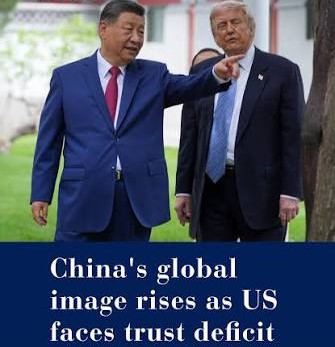
Trump’s policies have eroded America’s credibility in the world
In fact, the United States had already gained global recognition as the world’s foremost superpower after the end of World War II in 1945. By then, America, in addition to being a nuclear-armed nation, had also begun to play a leading role in the formation of the United Nations. The US dollar had also begun to play its global role. Although the Soviet Union had also been seen as the world’s second-largest superpower since 1945, the Soviet Union’s dissolution in 1991 left America as the sole global superpower. From that time on, America’s acceptance as “the world’s foremost superpower” became almost unquestionable. After that, America began to see itself not only as a global superpower but also as a “global police officer,” monitoring the internal affairs of almost every country in the world. Gradually, taking advantage of differences, tensions, or border disputes between two neighbouring countries, the United States began to establish military bases and deploy American troops in countries around the world. According to one estimate, the US currently operates over 750 military bases worldwide. These bases are spread across approximately 80 different countries. These include permanent bases, air bases, naval bases, logistics centres, and smaller “lily pad” forward operating locations. According to a recent Pentagon report, by 2026, more than 108,000 US troops will be deployed or forward-positioned in approximately 160 countries. US troop deployments span far more countries than military bases. Japan, Germany, and South Korea are among the countries with the largest concentrations of US military bases and US troop deployments.
On the other hand, in the 1970s and 1980s, China began to be envisioned as a “future superpower.” By the 1990s and 2000s, it was seen as an “emerging superpower.” And since 2010, China has been regarded as a genuine global superpower, practically equal to or surpassing the United States. China, which until four decades ago was considered one of the world’s poorest countries, rapidly grew through reforms after 1978 to become the world’s second-largest economy and today plays a central role in global production and supply chains. Large-scale manufacturing, export-led development, special economic zones open to foreign investment, and a low-cost workforce have made China a pivotal force in the global economy. During this same period, China modernized its military and invested heavily in its naval, missile, and space programs, leading it to be seen as not only a global economic superpower but also a strategic one. Its rapid progress in 5G, AI, space launches, and high-tech manufacturing, under strategies like “Made in China 2025,” also strengthened its image as a technological superpower globally. Through the Belt and Road Initiative, China enhanced its geopolitical influence and diplomatic clout, a key attribute of a superpower, by investing and lending to infrastructure in Asia, Africa, and Europe. Furthermore, its assertive stance on Taiwan, the South China Sea, and border disputes conveyed that it seeks to play at the global level, not regionally. However, a significant difference between the global policies of the US and China is that, unlike the US, China refrained from unnecessary interference in regional affairs, instead of treating other countries like a “policeman,” and refrained from vulture-like pursuit of other countries’ natural resources. It did not resort to petty tactics like inciting conflict, selling weapons to a country, seizing control of a country, threatening to kidnap a head of state.
The consequences of these policies, both of China and Xi Jinping, and of the United States and Donald Trump, were recently reflected in the latest global survey by the American research organization, the Pew Research Centre. The survey found that China’s popularity and trust in them have increased compared to the United States, and Xi Jinping’s popularity and trust in them have increased compared to Trump. This survey was conducted recently in 36 countries by the American research organization. According to the survey findings, people in approximately 25 of the 36 countries expressed a more positive opinion of China than of the United States. In the same survey, Xi Jinxing received more trust than Donald Trump in terms of his ability and credibility to handle world affairs. This survey clearly revealed for the first time that China’s image has become more positive than the United States in many countries, whereas for the past two decades, the United States’ image had generally been better than China’s. In 27 countries, people viewed China more favourably than the United States, considering China a better partner, investor, and stable power. In many countries, people expressed more confidence in Xi Jinping than Donald Trump in his ability to handle international affairs. Surprisingly, in nearly 22 of the 36 countries surveyed, people considered Xi Jinxing a better or more preferable leader than Trump, including important Western nations like Canada, Mexico, France, Germany, and the United Kingdom. Trust in Trump’s leadership remained very low in many countries. In an earlier global survey, 70% of respondents expressed distrust in Trump on international affairs, reflecting long-standing “suspicions” about him. Many developing countries also feel that China provides them immediate assistance in roads, ports, industry, and digital infrastructure, while US assistance is often based on political conditions and tied to security alliances. China has cultivated an image of a “development partner” in many parts of Asia, Africa, Latin America, and Europe through infrastructure investments, loans, and projects like the Belt and Road Initiative, leading to its public perception of China as a force for opportunity. This same survey and its analysis clearly state that many decisions during the Trump administration have significantly damaged America’s image. Factors such as strained relations with allies, cuts in foreign aid, bitter trade disputes, and a reluctance to engage with international institutions. Trump’s language, his controversial statements toward Muslim countries, immigrants, and allies, and his repeated attacks on NATO, the European Union, and international organizations have eroded both his personal trust and the world’s trust in America. Trump’s policies toward Iran, Israel, the Middle East, Venezuela, and Ukraine have all contributed to the decline. It’s no mistake to say that Trump’s policies are responsible for America’s global decline.
By Tanveer Jafri
(About the Author)
Author Tanveer Jafri is a columnist based in India.He is related with hundreds of most popular daily news papers/magazines and news portals in India and abroad. Jafri, Almost writes in the field of communal harmony, world peace, anti communalism, anti terrorism, national integration, national & international politics etc.He is a devoted social activist for world peace, unity, integrity & global brotherhood. Thousands of articles of the author have been published in different newspapers, websites & newsportals throughout the world. He is also a recipient of so many awards in the field of Communal Harmony & other social activities. (Email : tjafri1@gmail.com )
Be the first to comment