
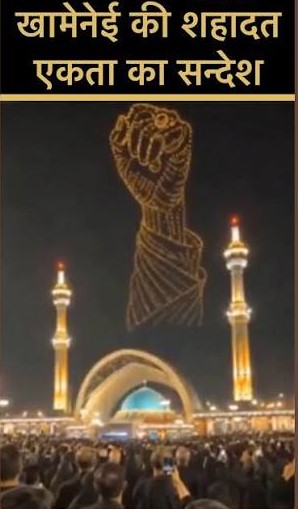
The clenched fist: Iran’s symbol of opposition to imperialism
The world witnessed the world’s largest funeral for Iranian Supreme Leader Martyr Ayatollah Khamenei, held between July 4th and 9th. The funeral procession, which lasted nearly a week, covered nearly two thousand kilometres across Iran and Iraq. To divide the crowd of millions, funeral prayers were held in several major cities, including Tehran. This historic gathering not only paid tearful tribute to their leader and his family members, martyred in the US-Israeli missile attack, but also expressed immense anger. Millions of people held red flags, symbolizing revenge, while hundreds of banners and posters, bearing the words “Kill Trump” in English, conveyed a direct message from Iranians to the United States. Among these flags, posters, and banners filled with messages of grief and anger, a special symbol caught the world’s attention: the symbol of a ‘clenched fist’. It is reported that his fist was clenched even at the time of martyrdom.
In fact, the clenched fist generally signifies resistance, solidarity, and continued struggle. In the context of Ayatollah Khamenei’s martyrdom, it was interpreted by his supporters, both political and religious parties, as a message that they stand by his legacy, his ideology, and the current power structure in Iran. History bears witness that the clenched fist has previously been a symbol of resistance and determination in many global movements around the world, especially against imperialist powers. This symbol is understood not only as a symbol of mourning but also as a political message such as “We will not retreat,” “We will remain steadfast,” “Our resolve is firm, and we are united.” Similarly, in the posters put up after Khamenei’s martyrdom, the clenched fist was used as a symbol of the continuity of his power, ideology, and support network. This could also mean that his followers are not simply seeing this as a death, but rather the beginning of a new phase of struggle and resistance. Furthermore, in the Shia community, which draws inspiration from the Dastan-e-Karbala, the language of mourning, vengeance, and justice is considered very important in politics and symbolism. Therefore, such images also emotionally convey that the community is transforming the “martyrdom” or death of its leader into both personal grief and collective resolve. The clenched fist also signifies that while we are in mourning, we are not weak and will continue our path of resistance. The clenched fist symbol also indicates that we are not weak, scattered, or leaderless; rather, our organization, ideology, and collective discipline remain strong.
Posters and symbols operate not only through logic but also through emotion. The clenched fist transforms grief into anger, memory, and the politics of revenge, strengthening a collective identity and an “us versus them” sentiment among supporters. Such posters also serve as tools in internal power struggles, as they unite supporters around a single axis during times of succession or leadership vacancy. This sends the message to the public that the regime is still in control and has not collapsed. Such symbols generally exert a profound influence on three levels: first, by boosting the morale of supporters on the street, second, by demonstrating the legitimacy of the leadership, and third, by signalling to its opponents that the ideological struggle will continue. Therefore, it should be understood not simply as an image, but as a political communication strategy. Furthermore, this symbol serves as a warning to the outside world that the pro-Iran faction will not bow to the pressure of any self-proclaimed superpower. The appearance of such a symbol in posters and banners among millions of mourners at the funeral of Martyr Khamenei in Iran, as well as the repeated raising of this symbol in anger by millions of people present, and the loud slogans against America and Israel, have given a direct message to the rivals.
The world is already witnessing the imperialist intentions of US President Donald Trump and his close ally, Israel. The US and Israel have spared no effort in destroying numerous countries, including Gaza, Palestine, Lebanon, Syria, Yemen, Iran, Iraq, Venezuela, and more. They issue threats to any country they choose, even threatening to occupy it. These imperialist countries conspire to undermine the sovereignty of other countries by forcibly seizing their wealth, natural resources, and even their possessions. To achieve these nefarious intentions, they engage in despicable games of divide and rule, sowing fear and distrust in neighbouring countries, and selling their weapons under this cover. Countries around the world avoid direct confrontation due to their power. However, Iran has shattered the myth that these imperialist countries cannot be confronted. From military power to political and diplomatic power, the self-proclaimed almighty United States, Israel, and all their allies have been shown that the power of a closed fist, when walking on the path of truth, can bring even the world’s most powerful nation to its knees. And now the world is beginning to accept that the world order will no longer be dictated to by imperialist America. The question arises: will Khamenei’s closed fist become Iran’s new symbol of opposition to imperialism? Contact: 9896219228
By Author
Tanveer Jafri
(About the Author)
Author Tanveer Jafri is a columnist based in India.He is related with hundreds of most popular daily news papers/magazines and news portals in India and abroad. Jafri, Almost writes in the field of communal harmony, world peace, anti communalism, anti terrorism, national integration, national & international politics etc.He is a devoted social activist for world peace, unity, integrity & global brotherhood. Thousands of articles of the author have been published in different newspapers, websites & newsportals throughout the world. He is also a recipient of so many awards in the field of Communal Harmony & other social activities.
(Email : tjafri1@gmail.com )
Be the first to comment